- Stein is reaching out to the audience of people who share joint views with him, and utilizing the general purpose of reaffirming shared convictions; he is simply taking a rather conversational tone with his reader. Last Class Notes: I believe Stein is specifically targeting the group of people that share his view, but his purpose is not general, it seems to be strictly specific. His verbiage and tone seem to almost want to encourage his audience to foster identification and self awareness of the rampant American exceptionalism that seems to fly pretty quietly under the common person’s radar of notice. It almost feels like he is trying to shake the reader by the shoulders and say “Look around!” It isn’t a call to action by any means, but however I do think it feels like a firm slap of sense to the face of the reader.
- Further Class Notes: Stein could be leaning toward audience three, those that wish to understand his viewpoint and perspective. He may very well be trying to persuade that version of the population to his side of things, not necessarily only to audience two. Stein is trying to intentionally poke at the readers, to incite a reaction but also make them think. “If you want people to change their POV, you must start a conversation.”
- Yes and no. He is being audience friendly to the people who can read his irony and sarcasm; aka audience two. But to those who can not, or rather don’t know how to, read between the lines and see his discussion as sarcastic, I would say he almost alienates his audience in that respect. That is what makes me think he is writing more so for his audience that shares his views because they can almost immediately identify his tone and irony and understand that he is in fact cracking a joke in the form of his baseball metaphor. So, in respect to the audience that is “in on the joke;” I think he is 100% writing for them and is very audience friendly. But if you wish to claim that he is writing for audience two, who wishes to understand his viewpoint, I would say no. He isn’t; he isn’t audience friendly to them but he does force them to think about the points and parallels he brings up during the article. He is influential to that group, but not necessarily friendly. Class Notes: Stein purposely makes himself not likable, forcing to the reader to hate-read; uses sarcasm; uses American past time to point out America’s flaws as a country. Intentionally invoking a response to force the reader to look into his work more to understand his true intention. He wants to be the antagonist; the narrator is not the writer, if you get that, he may appeal to you as an author –> stylistic choice as an author. Purposely makes himself out to be a know-it-all; invites people to pay more attention to him because he again, is invoking a response.
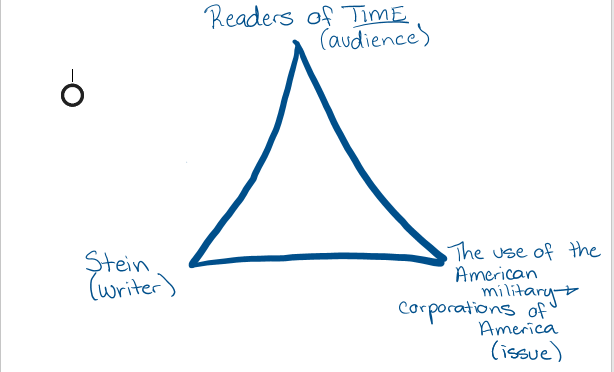
- I believe that Stein doesn’t think his readers understand the gross miss-use of the American military and the immense greed displayed by the American corporations; or at the very least he thinks that his readers do not understand the gravity of the effect of those two topics. Maybe Stein is convinced that the American people do not pay attention to the things they should, and he is drawing attention to these issues that he feels are important enough to argue to the American public; or at the very least, if he isn’t trying to convince his audience, he may just be trying to wake his audience up to the immense power that the military and corporations have and how we, as Americans, should be paying attention to who controls them and how they effect us.
- I think Stein has succeeded in bringing attention to the gap in this conversation, but he may not have filled the entire gap, but a conversation has been started involving the topic he seems to be trying to get across. He has invoked a conversation, which seems to be the purpose of a argument paper.
- I think I feel comfortable with my previous answer to number three; considering everything within literature and especially rhetorical literature is up for interpretation, I am happy with my interpretation of this piece and all the questions accompanying it.
- The danger of an essay like this is that Stein is instigating an argument and a conversation in a very aggressive sense; meaning he could easily incite both side of the debate on radical fronts. Instead of having a peaceful discussion, this could very well encourage a civil war almost among both sides of the debate.
- Class Notes Regarding the Last Few Questions: Reader should be more informed and research world events. Draw attention to the bravado of the American ethos; projecting on national misinformation. Read at face value, people won’t get it or could cause a controversy on Stein’s name as an author.
 Mary's Blog