HW 03/26

  • Basic Terms:
    • Auteur: author
    • Diegesis: includes objects, events, spaces and the characters that inhabit them, including things, actions, and attitudes not explicitly presented in the film but inferred by the audience.
    • Editing: joining together of clips of film into a single filmstrip.
    • Flashback Flashforward: A jump backwards or forwards in diegetic time. With the use of flashback / flashforward the order of events in the plot no longer matches the order of events in the story.
    • Focus:  refers to the degree to which light rays coming from any particular part of an object pass through the lens and reconverge at the same point on a frame of the film negative, creating sharp outlines and distinct textures that match the original object.
    • Genres: types of film recognized by audiences and/or producers, sometimes retrospectively.
    • Mise-en-scene: all the things that are “put in the scene”: the setting, the decor, the lighting, the costumes, the performance etc.
    • Story/Plot: perhaps more correctly labelled fabula and syuzhet, story refers to all the audience infers about the events that occur in the diegesis on the basis of what they are shown by the plot — the events that are directly presented in the film.
    • Scene/Sequence: a scene is a segment of a narrative film that usually takes place in a single time and place, often with the same characters.
    • Shot: a single stream of images, uninterrupted by editing.
  • Mise-en-scene:
    • The representation of space affects the reading of a film. Depth, proximity, size and proportions of the places and objects in a film can be manipulated through camera placement and lenses, lighting, decor, effectively determining mood or relationships between elements in the diegetic world.
    • Decor: An important element of “putting in the scene” is décor, the objects contained in and the setting of a scene. Décor can be used to amplify character emotion or the dominant mood of a film.
    • Rear Projection: Usually used to combine foreground action, often actors in conversation, with a background often shot earlier, on location. Rear projection provides an economical way to set films in exotic or dangerous locations without having to transport expensive stars or endure demanding conditions.
    • Lighting: The intensity, direction, and quality of lighting have a profound effect on the way an image is perceived.
    • Three-Point Lighting: The standard lighting scheme for classical narrative cinema. In order to model an actor’s face (or another object) with a sense of depth, light from three directions is used, as in the diagram below.
    • High-Key Lighting: A lighting scheme in which the fill light is raised to almost the same level as the key light. This produces images that are usually very bright and that feature few shadows on the principal subjects. 
    • Low-Key Lighting: A lighting scheme that employs very little fill light, creating strong contrasts between the brightest and darkest parts of an image and often creating strong shadows that obscure parts of the principal subjects. 
    • Space: The representation of space affects the reading of a film. Depth, proximity, size and proportions of the places and objects in a film can be manipulated through camera placement and lenses, lighting, decor, effectively determining mood or relationships between elements in the diegetic world.
    • Deep Space: A film utilizes deep space when significant elements of an image are positioned both near to and distant from the camera. For deep space these objects do not have to be in focus, a defining characteristic of deep focus. 
    • Frontality: Frontality refers to the staging of elements, often human figures, so that they face the camera square-on. This arrangement is an alternative to oblique staging. Frontal staging is usually avoided by the invisible style of continuity editing, since it supposedly breaks the spectator’s illusion of peeking into a separate world, by having characters look directly into the camera as if they were aware of the viewers’ presence.
    • Matte Shot: A process shot in which two photographic images (usually background and foreground) are combined into a single image using an optical printer. Matte shots can be used to add elements to a realistic scene or to create fantasy spaces.
    • Offscreen Space: Space that exists in the diegesis but that is not visible in the frame. Offscreen space becomes significant when the viewer’s attention is called to an event or presence in the diegesis that is not visible in the frame. 
    • Shallow Space: The opposite of deep space, in shallow space the image is staged with very little depth. The figures in the image occupy the same or closely positioned planes. While the resulting image loses realistic appeal, its flatness enhances its pictorial qualities. Striking graphic patters can be achieved through shallow space. 
    • Costume: Costume simply refers to the clothes that characters wear. Costume in narrative cinema is used to signify character, or advertise particular fashions, or to make clear distinctions between characters.
    • Acting: There is enormous historical and cultural variation in performance styles in the cinema. 
    • Typage: Typage refers to the selection of actors on the basis that their facial or bodily features readily convey the truth of the character the actor plays. Usually associated with the Soviet Montage school, these filmmakers thought that the life-experience of a non-actor guaranteed the authenticity of their performance when they attempted a dramatic role similar to their real social role. Typage is related to the use of stereotype in communicating the essential qualities of a character.
  • Editing:
    • Devices:
      • Transitions: The shot is defined by editing but editing also works to join shots together. There are many ways of effecting that transition, some more evident than others. In the analytical tradition, editing serves to establish space and lead the viewer to the most salient aspects of a scene.
      • Cheat Cut: In the continuity editing system, a cut which purports to show continuous time and space from shot to shot but which actually mismatches the position of figures or objects in the scene.
      • Crosscutting AKA Parallel Editing: Editing that alternates shots of two or more lines of action occurring in different places, usually simultaneously. The two actions are therefore linked, associating the characters from both lines of action.
      • Cut-In, Cut Away: An instantaneous shift from a distant framing to a closer view of some portion for the same space, and vice versa.
      • Dissolve: A transition between two shots during which the first image gradually disappears while the second image gradually appears; for a moment the two images blend in superimposition. Dissolves can be used as a fairly straighforward editing device to link any two scenes, or in more creative ways, for instance to suggest hallucinatory states.
      • Iris: A round, moving mask that can close down to end a scene (iris-out) or emphasize a detail, or it can open to begin a scene (iris-in) or to reveal more space around a detail. 
      • Jump Cuts: Jump cuts are used expressively, to suggest the ruminations or ambivalences of a character, or of his/her everyday life, but they are also a clear signifier of rupture with mainstream film storytelling. Rather than presenting a film as a perfectly self-contained story that seamlessly unfold in front of us, jump cuts are like utterances that evidentiates both the artificiality and the difficulties of telling such a story.
      • Establishing Shot/Reestablishing Shot: A shot, usually involving a distant framing, that shows the spatial relations among the important figures, objects, and setting in a scene. Usually, the first few shots in a scene are establishing shots, as they introduces us to a location and the space relationships inside it.
      • Superimposition: The exposure of more than one image on the same film strip. Unlike a dissolve, a superimposition does not signify a transition from one scene to another. The technique was often used to allow the same performer to appear simultaneously as two characters on the screen.
      • Wipe: A transition betwen shots in which a line passes across the screen, eliminating the first shot as it goes and replacing it with the next one. A very dynamic and noticeable transition, it is usually employed in action or adventure films. It often suggest a brief temporal ellypsis and a direct connection between the two images.
      • Matches: Editing matches refer to those techniques that join as well as divide two shots by making some form of connection between them.
      • Eyeline Match: A cut obeying the axis of action principle, in which the first shot shows a person off in one direction and the second shows a nearby space containing what he or she sees. If the person looks left, the following shot should imply that the looker is offscreen right.
      • Graphic Match: Two successive shots joined so as to create a strong similarity of compositional elements (e.g., color, shape).
      • Duration: Only since the introduction of editing to the cinema at the turn of the 20th century has not-editing become an option. The decision to extend a shot can be as significant as the decision to cut it. Editing can affect the experience of time in the cinema by creating a gap between screen time and diegetic time (overlapping editing) or by establishing a fast or slow rhythm for the scene.
      • Long Take, AKA Plan-Sequence: A shot that continues for an unusually lengthy time before the transition to the next shot. The average lenght per shot differs greatly for different times and places, but most contemporary films tend to have faster editing rates. 
      • Overlapping Editing: Cuts that repeat part or all of an action, thus expanding its viewing time and plot duration. Most commonly associated with experimental filmmmaking, due to its temporally disconcerting and purely graphic nature, it is also featured in films in which action and movement take precedence over plot and dialogue: sports documentaries, musicals, martial arts, etc.
      • Rhythm: The perceived rate and regularity of sounds, series of shots, and movements within the shots. Rhythmic factors include beat (or pulse), accent (or stress), and tempo (or pace). Rhythm is one of the essential features of a film, for it decisively contributes to its mood and overall impression on the spectator. It is also one of the most complex to analyze, since it is achieved through the combination of mise-en-scene, cinematography, sound and editing.
    • Styles: The patterned use of transitions, matches and duration can be identified as a cinematic style.
      • Continuity Editing: A system of cutting to maintain continuous and clear narrative action. Continuity editing relies upon matching screen direction, position, and temporal relations from shot to shot. The film supports the viewer’s assumption that space and time are contiguous between successive shots.
      • Montage: 1. A synonym for editing. 2. An approach to editing developed by the Soviet filmmakers of the 1920s such as Pudovkin, Vertov and Eisenstein; it emphasizes dynamic, often discontinuous, relationships between shots and the juxtaposition of images to create ideas not present in either shot by itself. Sergei Eisenstein, in particular, developed a complex theory of montage that included montage within the shot, between sound and image, multiple levels of overtones, as well as in the conflict between two shots.
      • Elliptical Editing: Shot transitions that omit parts of an event, causing an ellipses in plot and story duration. Elliptical editing need not be confined to a same place and time.

CL 03/26

Connection Between Unit One and Unit Two

  • Asks scientists to find differences between races; If science can prove that they are naturally inherently inferior or superior, it will change how the whole society works, naturally.
  • Discourse=disperse of knowledge –> multiliteracies are a part of discursive literature

Reflection Question

  •  Applying the work of Swales and Mirabelli, how do you think the discourse communities of law and science shaped the multi-literacies, thinking, and imaginations of audiences watching Birth of a Nation?
    • Law and science are multiliteracies that the general population seems to hold to high moral integrity. As such, they are rarely questioned but the common sense portion of the brain of the common person. It is a multiliteracy that is held to high standard in our society as a whole, never questioned. It is a common and socially accepted truth. This shapes our society because the common lay people are almost sheep-like in the way they accept, spread and thereby twist information among themselves. “Facts” spoken/enforced by the law and science discourse community often shapes the communities of our societies as almost gospel speech. Hence, law and science speaks, the sheep listen and follow.

Film Background

  • Decor:
    • Décor can be used to amplify character emotion or the dominant mood of a film.
    • Element of “putting the scene” of the movie.
    • Simple prop stagings can inflict a lot of unconscious emotion on the film and audience without even really being obvious.
  • Costume:
    • Costume in narrative cinema is used to signify character, or advertise particular fashions, or to make clear distinctions between characters.
    • Costumes can be used to build character through background, culture, type of wear, frequency of wear, what is being worn, everyday life, etc.
    • Clothing not only signifies the characterization of the character itself, but it gives an insight on the who the character is supposed to be and what they are written to be.
  • Typage:
    • Typage refers to the selection of actors on the basis that their facial or bodily features readily convey the truth of the character the actor plays.
    • Typage is related to the use of stereotype in communicating the essential qualities of a character.
    • Although current casting practices can no longer be described as typage, the use of performers with experience in the role they played is common to most films, whether they rely on the star system, or on non-professional actors.
    • Stories have characters, characters are built on stereotypes.

Film Editing

  • Iris:
    • A round, moving mask that can close down to end a scene (iris-out) or emphasize a detail, or it can open to begin a scene (iris-in) or to reveal more space around a detail.
    • Iris is a common device of early films (at at time when some techniques like elliptical editing, continuity editing, but feature prominently in avant-garde and radical filmmaking.
  • Parallel:
    • Editing that alternates shots of two or more lines of action occurring in different places, usually simultaneously. The two actions are therefore linked, associating the characters from both lines of action.

Birth of a Nation Film

  • 47 mins – 48:50 mins
    • iris shot opening up on the two children and man
    • panning over to a group of travelers
    • costumes suggest poor, weak, and abandoned; desperate
    • the stark color changes suggest a strongly different tone; red=war, pain, blue=sad, hopeless
    • the parallel shots between these two scenes shows a stark difference
    • stereotyping the “weak woman protecting her children in a time of war”
  • 19 mins – 21:42 mins
    • costume indicates a higher class woman entertaining a high class gentleman
    • decor states a well taken care of house, two white persons would own during this time period
    • dated prop staging suggests time period
    • woman’s distaste for the man she serves indicates the servant’s feelings toward the entitled white man of the decade
    • “the great leader’s weakness is a blight to the nation”
    • the woman weeps while the man scolds, is it fake crying?
    • further examination, the costume almost indicates a servant instead of a high class woman
    • the man didn’t realize how he treated the woman until he took his head out of his own intention and actually looked at her plight… metaphor for the white man’s bull-headed nature and ignorance?
  • 1:32:19 mins – 1:37:00 mins
    • “put the white South under the heel of the black South” -Woodrow Wilson “…The white men were roused by a mere instinct of self-preservation.”
    • lots of text in place of exposition
    • iris scene opening; to signify a move in the story
    • a room full of white high class men and one high class lady entering draws all their attention? interesting.
    • the costume indicates the same placement as the previous scene, yet full of high class persons instead of a single on and their servant.
    • iris editing to focus on the individuals speaking; “Don’t scrape to me. You are the equal of any man here.”
    • a grand show of equality among white men
    • the high class lady is dressed in such a way that her simple makeup seems to portray her as mixed heritage between blacks and whites; but why is she being forced to separate from their proceedings in the previous room?

CL 03/12

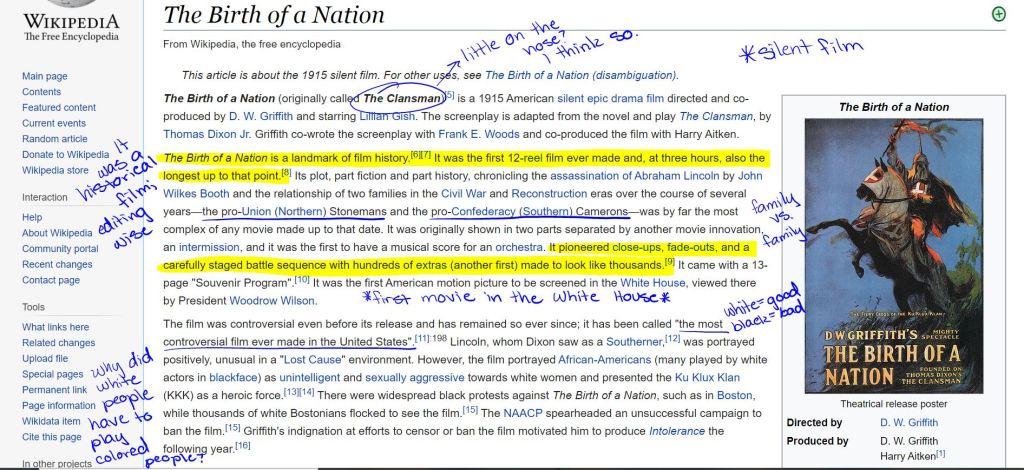
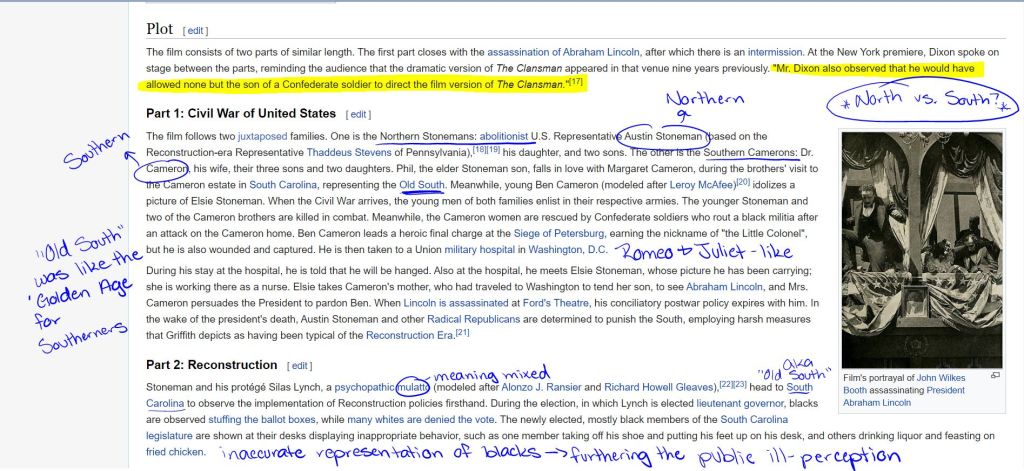
The Birth of a Nation

  • Directed by DW Griffith
  • made in the San Fernando Valley
  • Premiered in theaters in 1915
  • Based on the book The Clansman; written by Thomas Dixon, a former preacher
  • Birth of a Nation= exceptionally racist; beliefs of white supremacy
    • yet it is still praised for its technical virtuosity
  • Often panned for its demeaning and racist interpretation of African-Americans
    • “moonlight and magnolias”=everything is perfect
  • Historically inaccurate and inflammatory
  • It was convincing because it matched the public opinion of the time
  • Why are are watching this?
    • As an example of discourse shapes worldviews and real life events
    • As an example of how discourse shapes textual production
    • As an example of multiliteracies
    • As a demonstration of how the ideology of white supremacy led to a revisionist retelling of the Civil War and Reconstruction

Rough Draft: Assignment One

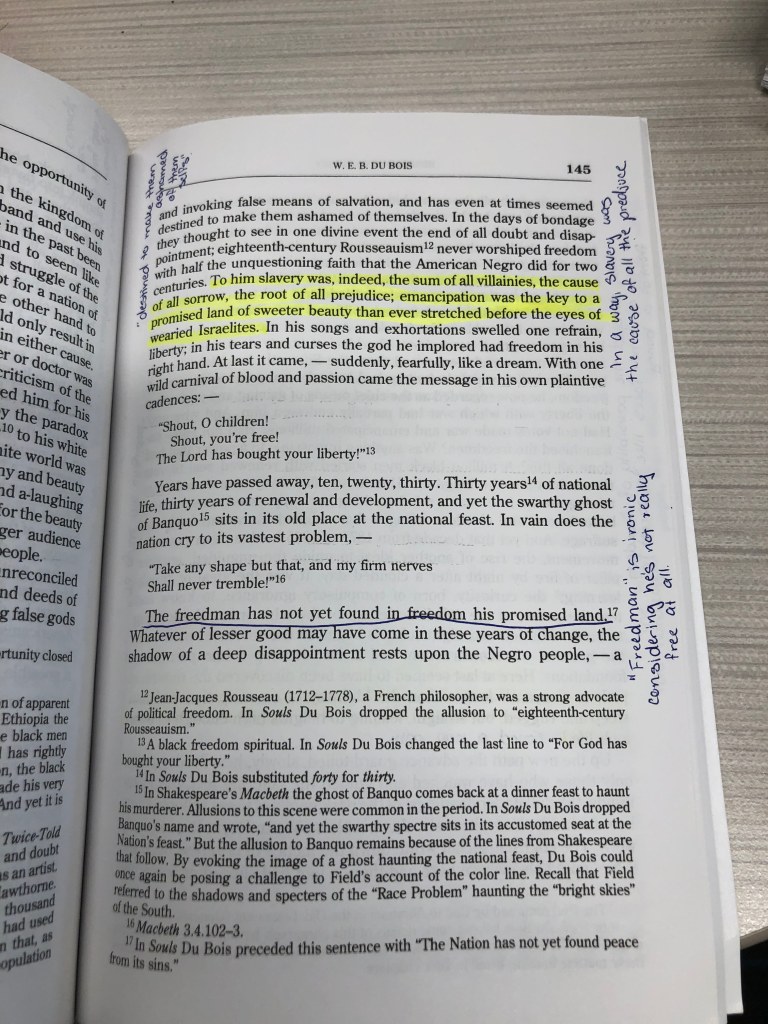
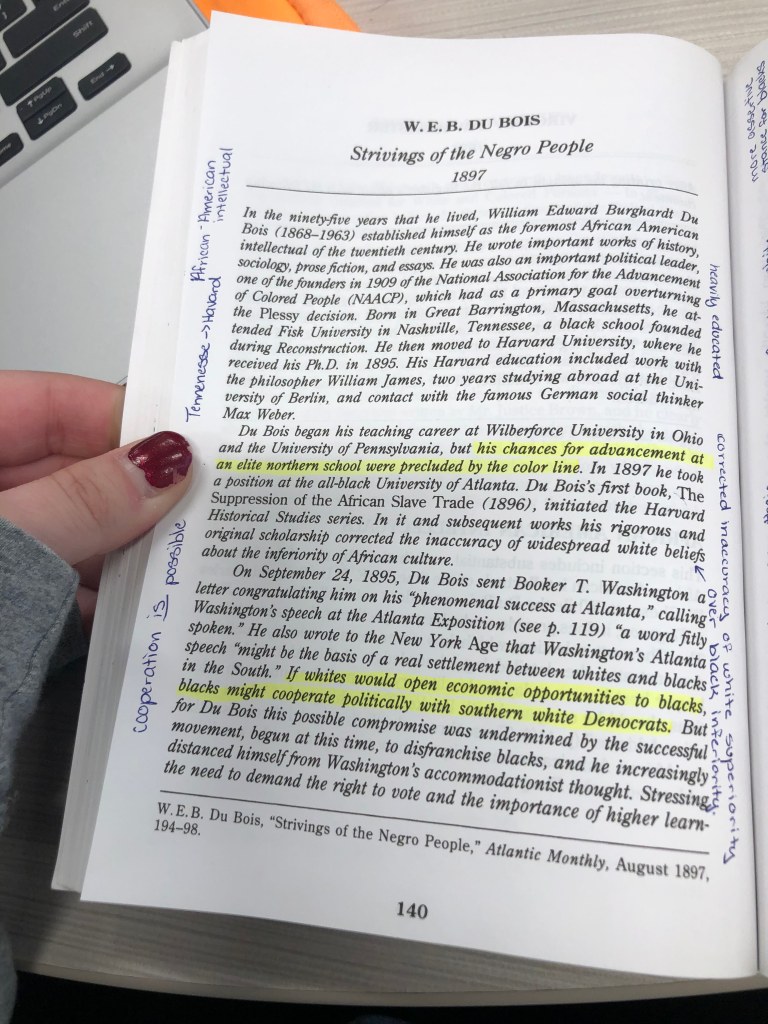
W.E.B Du Bois was an educated black man writing to a public, that as far as they were concerned, didn’t even think Du Bois deserved to exist in their ‘white America.” Although, in 1897 when Du Bois wrote his influential piece titled “Strivings of the Negro People”, there were amendments in place to abolish slavery and limit the South’s strongly prejudicial tendencies involving the African Americans; the still suffered a major lack of personal identity and freedom.

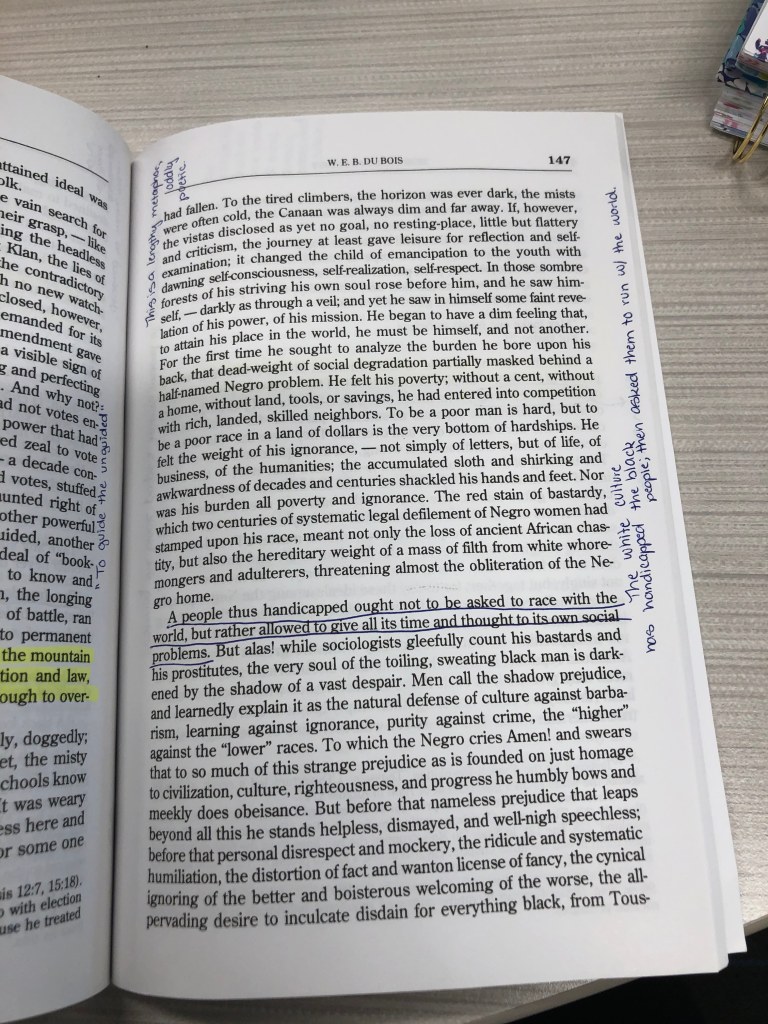
            Most authors during this time were white and may or may not have been well educated; they advocated for the African Americans to remain uneducated and below them in the social hierarchy. The white culture of America had become toxic that the intended goal was a type of social slavery to demean and belittle the African American race in American society, the two other essays the class has analyzed before Du Bois were all written by white men who advocated any excuse, whether born out of true science or not, what so ever in order to keep the black Americans on a lower self-worth and social-economic level than the white persons of the culture. They forced them to accept things at a lower pay rate, a lower respect level, and a lower humanity level than what they deserved in order to beat the idea of “white is American, you will always remain below that” into the minds and identities of African Americans.

            Du Bois is unique in the sense that his essay appealed to the ethos version of writing, meaning that he aimed to appeal to a white audience, but he targeted their emotions. The white culture had dehumanized the African Americans to such an extent that Du Bois saw that the only way to re-humanize them, therefore having the white man sympathize and mayhap even empathize with the African American struggle; was to appeal to the innermost emotion of a human being. Considering the discourse community that was spewing the discourse the public viewed as “truth” during this historical moment, it was a rather bold move of Du Bois to even publish this article to target the white culture that ultimately demonized his race and therefore himself.

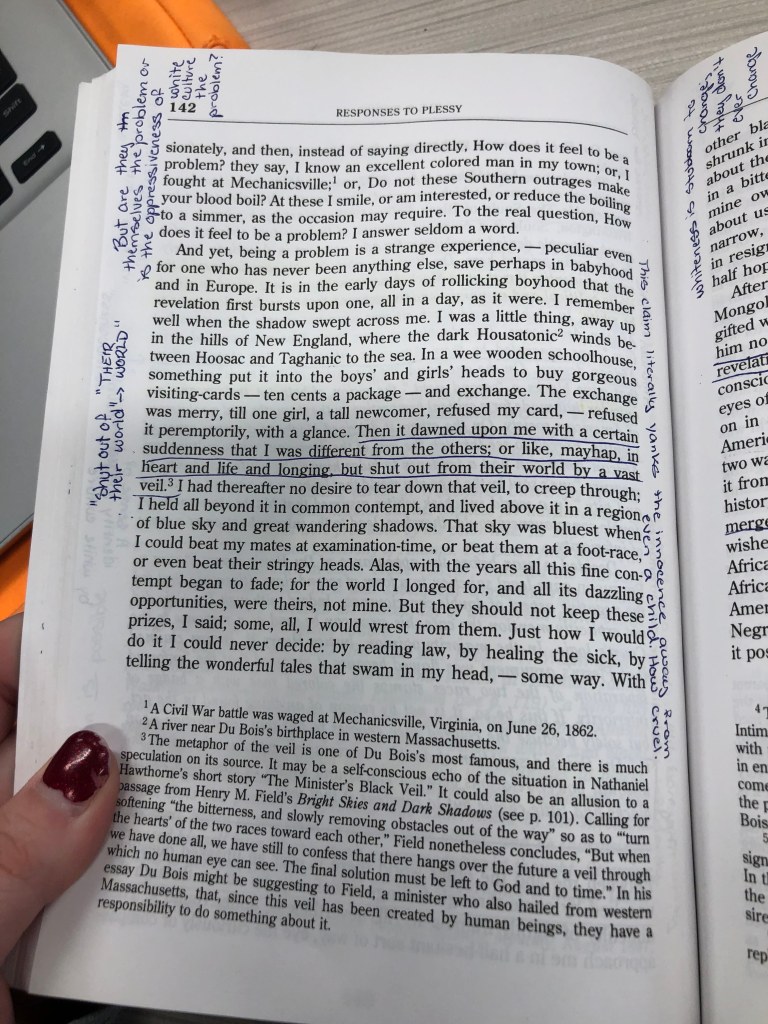
            The rhetoric Du Bois utilizes, as I explained earlier, is a unique approach to the Race Question proposed at this time period; his methods of persuasion and writing style very much stick out amongst the other writings during this time. In Plessy v. Ferguson, on p. 142-143 Du Bois replays a childhood experience of not recognizing that he was any different from the people around him; “Then it dawned upon me with a certain suddenness that I was different from the others; or like, mayhap, in heart and life and longing, but shut out from their world by a vast veil” (PvF 142). The way that Du Bois writes, he uses a much softer and personal tone, his language doesn’t have a harsh, overly intellectual tone; when it is read by the reader, it sounds as a calm almost voice of reason. This author choice of tone during the reading, it is smart, and purposeful. And it works.

            The absolute cultural bias during this time period can be portrayed wonderfully by The Mismeasure of Man which portrays how the cultural bias seeped into every part of the American life, including science, which they claimed was the founding father of truth. The science of human worth was qualified by “biological determinism. It holds that shared behavioral norms, and the social and economic differences between human groups – primarily races, classes, and sexes – arise from inherited, inborn distinctions and that society, in this sense, is an accurate reflection of biology…the claim that worth can be assigned to individuals and groups by measured intelligence as a single quantity” (TMM p. 52). Looking from present day back on sciences like this, the average person knows it is wrong and simply ridiculous to think that one can measure another’s worth and intelligence from how many lead pellets can fit into different shaped skulls, i.e. craniometry. But intense, and quite frankly dumb practices like this pseudoscience displayed here, are the basis for most of the discrimination witnessed within this time period, all of which Du Bois is attempting to use his rhetoric and writing choices to humanize the African Americans that the white man seems so eager to classify as “less then.”

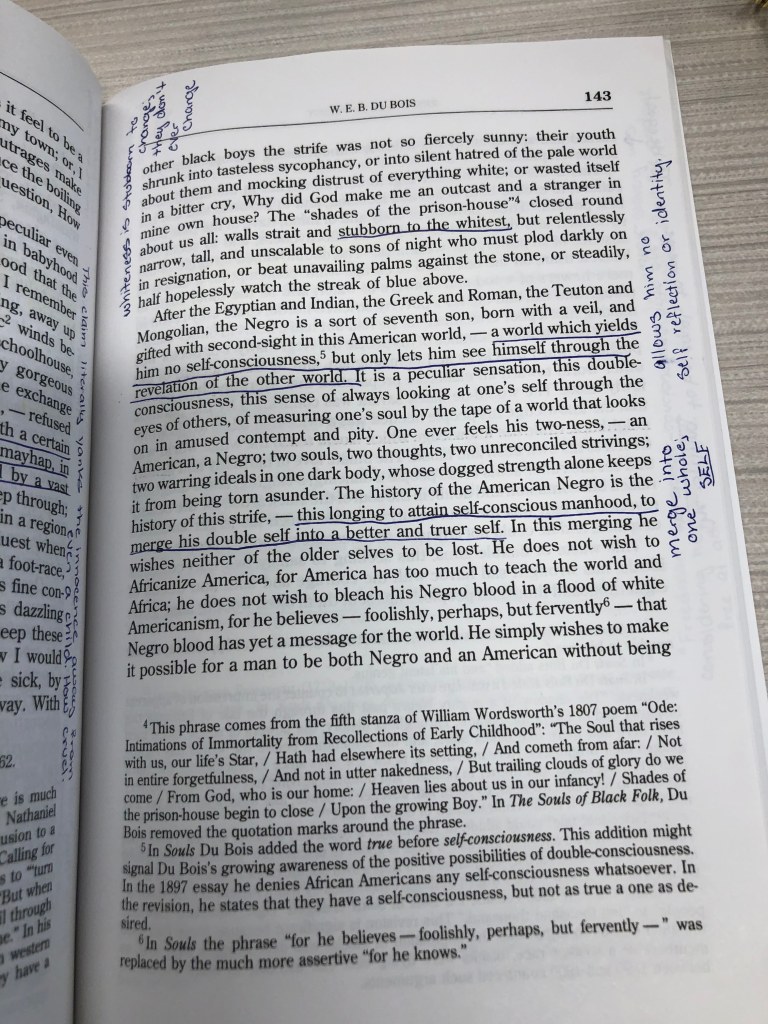
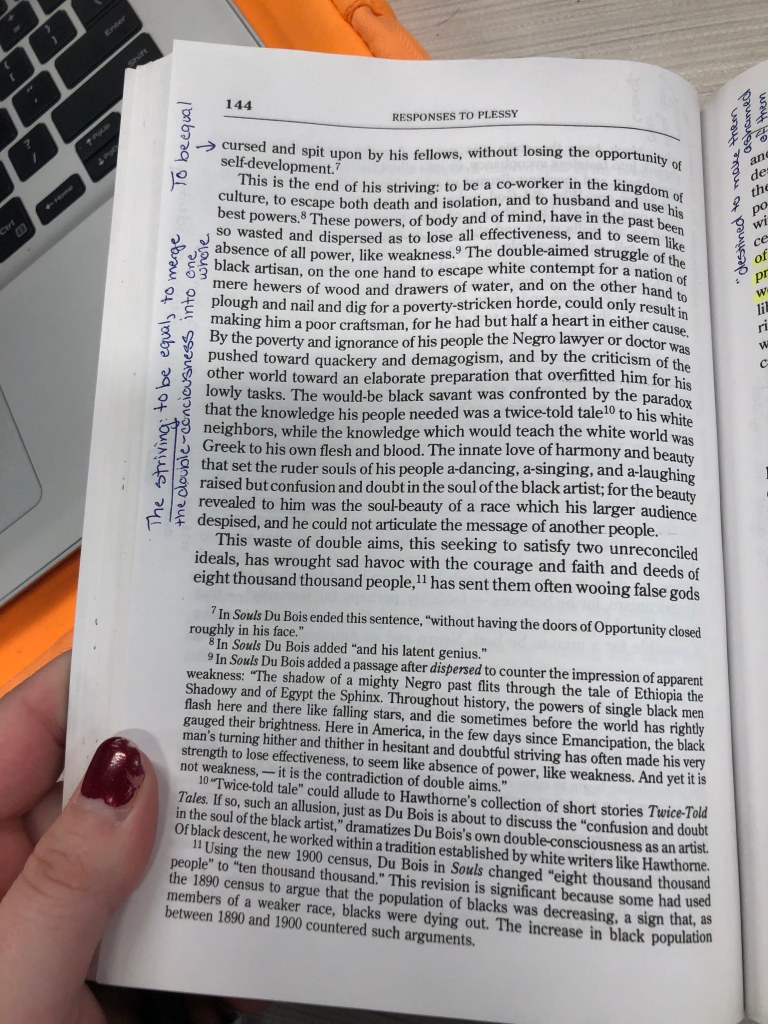
            Du Bois’ choice of personal tone, inflection, and experiences, not to mention him quoting Bible scripture during his essay are all high level and methodical approaches to make his reader feel how he feels as an isolated black man in a white America. Towards the end of the essay, he quotes a poem “May make one music as before, But vaster,” (PvF 148), along with this and his scripture quote and comparison of music and fairytales, Du Bois creates a beautiful painting relating to the staples of American society that the white man holds extremely dear to his personal identity. Along with this comparison, Du Bois appeals again to the ethos of a reader, by proposing his idea of “double consciousness,” claiming that the African American people have never had a chance to have their own self. They are always what society betrays them as, or simply what an individual view them as, and nothing more. They have never been able to simply be themselves and only themselves; they have no sense of self or self-worth or just simple worth.

HW 03/03

So I Have an Idea; But I Do Not Know How to Flesh this Bad Boy Out:

  • What to use? Du Bois & The Mismeasure of Man
  • Why? I wanted to analyze Du Bois emotional approach to the Race Question and I wanted to use The Mismeasure of Man to support that the racial segregation and hate ran so deep in American society that Du Bois’ emotional approach is the only thing that had actual ability to sway the “fence sitters.”
  • What is the Problem? I literally just do not know how to even begin this…
    • Am I even getting the point of the assignment?
    • Do I have the right idea for the assignment?
    • How do I even begin this?
    • Is this an analysis paper? Is it a persuasive paper?
    • Does this need a formal tone? An argumentative tone? A standard paper; intro, body, and conclusion?
    • Does the whole paper need to be in MLA format? Just the citations?
    • What are Dr. Bailie’s expectations?

I just have so many questions and I feel a little lost, I suppose.

The First Draft Is Listed Below

Enlightening Education: Selling Reason to the Ignorant

            W.E.B Du Bois was an educated black man writing to a public, that as far as they were concerned, didn’t even think Du Bois deserved to exist in their ‘white America.” Although, in 1897 when Du Bois wrote his influential piece titled “Strivings of the Negro People”, there were amendments in place to abolish slavery and limit the South’s strongly prejudicial tendencies involving the African Americans; the still suffered a major lack of personal identity and freedom.

            Most authors during this time were white and may or may not have been well educated; they advocated for the African Americans to remain uneducated and below them in the social hierarchy. The white culture of America had become toxic that the intended goal was a type of social slavery to demean and belittle the African American race in American society, the two other essays the class has analyzed before Du Bois were all written by white men who advocated any excuse, whether born out of true science or not, what so ever in order to keep the black Americans on a lower self-worth and social-economic level than the white persons of the culture. They forced them to accept things at a lower pay rate, a lower respect level, and a lower humanity level than what they deserved in order to beat the idea of “white is American, you will always remain below that” into the minds and identities of African Americans.

            Du Bois is unique in the sense that his essay appealed to the ethos version of writing, meaning that he aimed to appeal to a white audience, but he targeted their emotions. The white culture had dehumanized the African Americans to such an extent that Du Bois saw that the only way to re-humanize them, therefore having the white man sympathize and mayhap even empathize with the African American struggle; was to appeal to the innermost emotion of a human being. Considering the discourse community that was spewing the discourse the public viewed as “truth” during this historical moment, it was a rather bold move of Du Bois to even publish this article to target the white culture that ultimately demonized his race and therefore himself.

            The rhetoric Du Bois utilizes, as I explained earlier, is a unique approach to the Race Question proposed at this time period; his methods of persuasion and writing style very much stick out amongst the other writings during this time. In Plessy v. Ferguson, on p. 142-143 Du Bois replays a childhood experience of not recognizing that he was any different from the people around him; “Then it dawned upon me with a certain suddenness that I was different from the others; or like, mayhap, in heart and life and longing, but shut out from their world by a vast veil” (PvF 142). The way that Du Bois writes, he uses a much softer and personal tone, his language doesn’t have a harsh, overly intellectual tone; when it is read by the reader, it sounds as a calm almost voice of reason. This author choice of tone during the reading, it is smart, and purposeful. And it works.

            The absolute cultural bias during this time period can be portrayed wonderfully by The Mismeasure of Man which portrays how the cultural bias seeped into every part of the American life, including science, which they claimed was the founding father of truth. The science of human worth was qualified by “biological determinism. It holds that shared behavioral norms, and the social and economic differences between human groups – primarily races, classes, and sexes – arise from inherited, inborn distinctions and that society, in this sense, is an accurate reflection of biology…the claim that worth can be assigned to individuals and groups by measured intelligence as a single quantity” (TMM p. 52). Looking from present day back on sciences like this, the average person knows it is wrong and simply ridiculous to think that one can measure another’s worth and intelligence from how many lead pellets can fit into different shaped skulls, i.e. craniometry. But intense, and quite frankly dumb practices like this pseudoscience displayed here, are the basis for most of the discrimination witnessed within this time period, all of which Du Bois is attempting to use his rhetoric and writing choices to humanize the African Americans that the white man seems so eager to classify as “less then.”

            Du Bois’ choice of personal tone, inflection, and experiences, not to mention him quoting Bible scripture during his essay are all high level and methodical approaches to make his reader feel how he feels as an isolated black man in a white America. Towards the end of the essay, he quotes a poem “May make one music as before, But vaster,” (PvF 148), along with this and his scripture quote and comparison of music and fairytales, Du Bois creates a beautiful painting relating to the staples of American society that the white man holds extremely dear to his personal identity. Along with this comparison, Du Bois appeals again to the ethos of a reader, by proposing his idea of “double consciousness,” claiming that the African American people have never had a chance to have their own self. They are always what society betrays them as, or simply what an individual view them as, and nothing more. They have never been able to simply be themselves and only themselves; they have no sense of self or self-worth or just simple worth.
CL 03/03

  • Warrant: unspoken values a writer thinks they share with their readers
  • Specific discourse community
  • Argument Style: (evidence, reason, format, genre) comes from the discourse community
  • Knowledge: made through discourse and creates multi-literacies for individuals to use.
Du Bois Triangle
  • Du Bois’ Claim: African Americans deserve the same rights as white Americans because they are basic human rights.
  • Note the use of double consciousness.

CL 02/27

Continuing Work with John Tyler Morgan “The Race Question in the United States”

  • The Rhetorical Appeal here is…Emotion: FEAR, and lots of it.
  • Warrant: Blacks are inferior to whites.
    • Claim: It is a waste to give Black Americans rights; civil or other wise.
    • Reasons: No white American will ever see them as anything other than a slave.
    • Evidence: PvF p. 67 –> Common Law of the race since the beginning of the race; naturally inferior
  • Counterargument: None??
  • Rebuttal:
  • Obtaining information from “natural scientists” and “social scientists” during this time period; drawing from what they create and labeling it as “knowledge.”
  • Morgan’s essay is supposed to be an argumentative essay meant to persuade the public to his stance.

Further Class Notes Involving Du Bois

  • Ethos- trustworthy person
  • Pathos- emotion
  • Logos- reason
  • Most readers during this time period would be white, they were the literate ones in the day; appeal to non-racist to see black Americans as people.
  • Evidence backs the person’s recounting and life in America.
  • Du Bois is using his experience to justify his evidence instead of the racist information published by the scientists infested with the idea of biological determination.
  • Black life is undocumented at this time period.
Design a site like this with WordPress.com
Get started