CL 02/06

Why does Swales suck? Or Rather…Why does his Essay Suck?

  • The vocab is a bit too advanced; seems unnecessary
  • It is written as if we should know all of this background knowledge and vocab; why??
  • I can not figure out if he is trying to break down the concept of a discourse community or just trying to figure out what the definition of it is

CLASS NOTES

  • Took too long to get to the point
  • The example of the Hong Kong stamp club example was too niche
  • The article itself is strictly pertaining to the idea of a Discourse Community; which in reality does not offer anything to the real world concept of things
  • It was for a class

Swales Questions

  • Swales seems to see that the gap in the conversation is that no one is discussing that the concept of a Discourse Community isn’t real. As in it is not connected to the real world, it is impractical in practice because such as with the Hong Kong stamp club, one person can not possibly speak the minds of a whole group of people. Swales seems to be pointing out that as well as the fact that a Discourse Community does not have a newly defined definition that would flow with the currently time period and culture.
  • Swales fills the gap by pointing out that there even is a gap in this very specific community. He draws attention to something that maybe the everyday person would not even think of, and to the people in the “in” community that understand his gripes, he is drawing attention to the major flaw within the entire domain of a Discourse Community.
  • The audience for this essay is most definitely aimed at the academic literature persons and/or the Discourse Community itself; the verbiage is most definitely not aimed at the everyday person.
  • Its boring; it is utterly mind numbingly boring beyond belief. You fall completely sleep before you even skirt close to the point that Swales is attempting to reach.

CLASS NOTES

  • Gap? There are different ways definitions of the discourse community and people often mix up speech community and discourse community.
  • Fills the gap by giving six criteria for the definition of discourse community guidelines.
  • Issue: What is a Discourse Community?
  • The audience is academics, in particular linguists. Due to the confusion among the community with the speech community vs. the discourse community Swales is writing as if everyone in his audience are students; he is over simplifying the topic.
  • Danger? Too deep; It shuts down any further research.
CL 02/04

In Defense of Domination

  • He is not really talking about baseball
  • He’s talking about the US military, its use, being in various places around the world
  • Unreliable narrator; Stein the writer and Stein the person are different people
  • Sarcasm, irony are used throughout
  • Wants to invoke a response due to the military topic
  • Appeared in TIME magazine
  • Purpose of piece: could be meditation, to answer a question
  • Could be writing for people who agree with him

Stein

  • Writes to evoke a response
  • Written other works using irony and sarcasm, sometimes gets him in trouble
  • Professional writer
  • Purpose of piece: effected by how Stein is projected through his past works; ultimately up to the reader
Joel Stein; sarcastic voice of a nation.

In Defense of Domination Essay

What is Stein’s purpose for writing this essay? Stein’s purpose for writing this essay seems to be to mock that America is in fact not the underdog. The very title is mocking towards the fact that the basic premise of “domination” is never defend able, but then Stein draws parallels to the American institution of nationalism and always being ready to defend itself, even when they do not need to be. Stein is simply mocking America; we are the ultimate overreacting ex-girlfriend that no one wants to talk to.

John Swales Discussion

  • A speech community are centripetal because they tend to absorb people into that general fabric and discourse communities are centrifugal meaning they tend to separate people into occupational or specialty-interest groups.
  • The Six Defining Characteristics of a Discourse Community:
    • 1) Broadly agreed set of public goals
    • 2) Mechanisms of intercommunication among members
    • 3) Participation for feedback and information
    • 4) Uses genres to further its aims as a community
    • 5) Genres to acquire specific lexis
    • 6) A discourse community has a threshold level of members with a suitable degree of relevant content and discoursal expertise.
  • Swales claims that the discourse community kind of works as a whole generalized stereotype when it actually isn’t representative as a community as a whole.

Why does this essay suck?

  • Takes too long to read
  • Wordy as hell
  • Not meant for students as an audience
  • Not written simply
  • It was boring
  • Why should I care?

HW 01/30

  • John Malcolm Swales was born in 1983, he is a famous linguist known for his literature genre analysis in the academic community. He graduated from Queens’ College in Cambridge in 1957 with a degree in psychology; which most likely attributes itself to why he enjoys analyzing literature, and also why he wrote so many parallels between psychology and discourse communities in his work The Concept of Community Discourse. Swales also took many different courses of academic literature and resided in a few select positions in the same community, this is also why he most likely writes as if the reader is one of his peers. It has most likely become a habit from years of living solely in the literature engrossed community to write with such a high academic caliber.
  • Swales’ ideal audience was probably someone in the academic community, most likely a classroom of students in a literature class; his verbiage and general structure of his essay feels like it was meant to be placed in a literature classroom to be analyzed by the class and professor. Kind of like what we’re doing right now in English Composition 2089.
  • The “issue” the article seems to be trying to address seems to be the distinct difference between a discourse community and a speech community AND the strong definition of a discourse community as a stand alone term.
  • Swales seemed to think that the “gap” in this discussion was the strong definition and differentiation of the term “discourse community.” Whereas for me, as a reader, his essay seemed to be repetitive of a concept I already grasped; however, for a standard run-of-the-mill person, once you could work your way through his verbiage and structure, he seemed to draw a pretty clear and concise version of what he viewed the definition of a discourse community to be and why it was so vastly different from a speech community. As a reader, I very much enjoyed his parallels to the psychology aspect of literature communities as well because I believe that both those concepts often go hand in hand with each other.

CL 01/30

  • Stein is reaching out to the audience of people who share joint views with him, and utilizing the general purpose of reaffirming shared convictions; he is simply taking a rather conversational tone with his reader. Last Class Notes: I believe Stein is specifically targeting the group of people that share his view, but his purpose is not general, it seems to be strictly specific. His verbiage and tone seem to almost want to encourage his audience to foster identification and self awareness of the rampant American exceptionalism that seems to fly pretty quietly under the common person’s radar of notice. It almost feels like he is trying to shake the reader by the shoulders and say “Look around!” It isn’t a call to action by any means, but however I do think it feels like a firm slap of sense to the face of the reader.
  • Further Class Notes: Stein could be leaning toward audience three, those that wish to understand his viewpoint and perspective. He may very well be trying to persuade that version of the population to his side of things, not necessarily only to audience two. Stein is trying to intentionally poke at the readers, to incite a reaction but also make them think. “If you want people to change their POV, you must start a conversation.”
  • Yes and no. He is being audience friendly to the people who can read his irony and sarcasm; aka audience two. But to those who can not, or rather don’t know how to, read between the lines and see his discussion as sarcastic, I would say he almost alienates his audience in that respect. That is what makes me think he is writing more so for his audience that shares his views because they can almost immediately identify his tone and irony and understand that he is in fact cracking a joke in the form of his baseball metaphor. So, in respect to the audience that is “in on the joke;” I think he is 100% writing for them and is very audience friendly. But if you wish to claim that he is writing for audience two, who wishes to understand his viewpoint, I would say no. He isn’t; he isn’t audience friendly to them but he does force them to think about the points and parallels he brings up during the article. He is influential to that group, but not necessarily friendly. Class Notes: Stein purposely makes himself not likable, forcing to the reader to hate-read; uses sarcasm; uses American past time to point out America’s flaws as a country. Intentionally invoking a response to force the reader to look into his work more to understand his true intention. He wants to be the antagonist; the narrator is not the writer, if you get that, he may appeal to you as an author –> stylistic choice as an author. Purposely makes himself out to be a know-it-all; invites people to pay more attention to him because he again, is invoking a response.
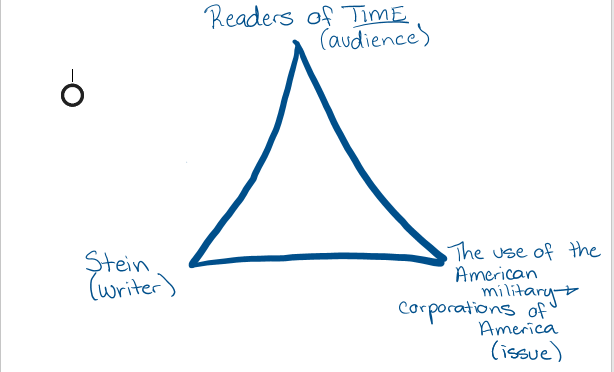
The Stein version of the “Rhetorical Triangle”
  • I believe that Stein doesn’t think his readers understand the gross miss-use of the American military and the immense greed displayed by the American corporations; or at the very least he thinks that his readers do not understand the gravity of the effect of those two topics. Maybe Stein is convinced that the American people do not pay attention to the things they should, and he is drawing attention to these issues that he feels are important enough to argue to the American public; or at the very least, if he isn’t trying to convince his audience, he may just be trying to wake his audience up to the immense power that the military and corporations have and how we, as Americans, should be paying attention to who controls them and how they effect us.
  • I think Stein has succeeded in bringing attention to the gap in this conversation, but he may not have filled the entire gap, but a conversation has been started involving the topic he seems to be trying to get across. He has invoked a conversation, which seems to be the purpose of a argument paper.
  • I think I feel comfortable with my previous answer to number three; considering everything within literature and especially rhetorical literature is up for interpretation, I am happy with my interpretation of this piece and all the questions accompanying it.
  • The danger of an essay like this is that Stein is instigating an argument and a conversation in a very aggressive sense; meaning he could easily incite both side of the debate on radical fronts. Instead of having a peaceful discussion, this could very well encourage a civil war almost among both sides of the debate.
  • Class Notes Regarding the Last Few Questions: Reader should be more informed and research world events. Draw attention to the bravado of the American ethos; projecting on national misinformation. Read at face value, people won’t get it or could cause a controversy on Stein’s name as an author.

CL 01/28

  • Considering last class we evaluated the Stein was drawing parallels to the American and Iraq war currently being waged across the pacific ocean in some big metaphor involving a baseball trade; I think his intended audience may have been to academic scholars. I am not sure if that is their official name, but I am not quite sure what else to call them; to be clear I am referencing people that read Shakespeare sonnets for fun. Critics! Literature critics? Whatever, you get my point. His writing style is so incredibly dry and ironic that the basic common everyday person reading the newspaper wouldn’t catch the deeply ironic tones tinging his words on the page. In fact, it almost seems like he wrote it to stir up the public while the academic-writer-types giggle behind closed doors, knowing that they are misinterpreting it. Or maybe he knew the public would react so violently, and he used that emotion to fuel his work being publicized, to reach a broader audience, so to speak. Nevertheless, Stein purposefully dismisses them as commoners, he almost talks down to them in a condescending tone throughout the peace; or so it would appear to the common person. But to me, it almost reads as if he is sitting in a bar with his best buddies and he’s nudging his one buddy and basically saying “Come on! Does no one else see what is so plain in front of them?!” Like when you try and get your friend to understand a concept, so you use an extended metaphor; that’s the tone I read Stein in. Class Notes: The article was published in TIME magazine, so the intended readers would probably be the public; specifically the TIME subscription holders. Everything in the realm of rhetorical reading and writing is always a perspective; there is no wrong or right answer. People like Stein who would READ the irony.
  • I did not get to answer this question in enough time, so I will just take Class Notes on this question. Class Notes: Stein refers to the public as “Yankee haters”; which inherently catches the attention of the public. People inherently feel strongly about sports, especially in America. We take it seriously. People either love or hate the Yankees. This is all a tactic in order for Stein to build his argument, it isn’t an objective argument as one would typically view in a STEM field level of argument. But it is still an argument method.
  • Other Class Notes Regarding the Stein Reading: Stein’s argument is that America has this “moral authority”; but why do we have the moral authority? What makes us so special that we have the exception and right to be the moral judge and jury? “Americanism”; why? American thinks of itself as bigger and better than the rest of the world –> Does Stein seem to think this is a good or a bad thing? That this idea of American exceptionalism, is it good or bad? Agree or disagree? Yes, they would agree that this sort of American exceptionalism as troubling, at the very least. Assuming, because this was published in TIME, that Stein’s intended audience did already believe his viewpoint and he was just reaffirming those values that everyone already believed in. Stein does not need to persuade his audience, because the audience is already left leaning regarding the mainstream American politics so he is essentially just “preaching to the choir.”
  • So then, how does he get his opinion across? How does he throw his opinion at the audience to appeal to them? Stein uses his blunt, and sarcastic tone to basically hammer some sense into the American brain; and so “everyone in the know” feels super smart, but the people on the outside of the academic level of writing, are probably the one’s being ridiculed.
  • Stein almost seems to use a slight, twisted form of Confirmation from The Brief Thompson p. 78. The concept of Confirmation is defined as the proof of the argument and thus argues the case, thesis, or main point of the contention. Stein uses it as a way to further prove his point of American exceptionalism by incorporating the large and extended Yankee metaphor. He also does treat his readers as intelligent, as much as the article may seem demeaning, it is written as if him and his audience are equals; if it is misconstrued as anything other than that, then you are not the intended audience. Class Notes: Yes; using Aristotle’s Art of Persuasion. Using a style of argument that works for his argument. Almost said no due to his lack of traditional evidence, however is isn’t working to change anyone’s opinion, he is just reaffirming shared values.
  • I believe Stein is specifically targeting the group of people that share his view, but his purpose is not general, it seems to be strictly specific. His verbiage and tone seem to almost want to encourage his audience to foster identification and self awareness of the rampant American exceptionalism that seems to fly pretty quietly under the common person’s radar of notice. It almost feels like he is trying to shake the reader by the shoulders and say “Look around!” It isn’t a call to action by any means, but however I do think it feels like a firm slap of sense to the face of the reader.

HW 01/21

Refer to the document linked with the button for my annotations for A Brief Thompson p.72-87

Purdue Owl Video Notes

  • Logos
  • Ethos
  • Pathos
  • Rhetoric: awareness of the the language we choose to use
  • Originated from Greek practice called “preparing speeches”
  • Sophists: believed they could teach anyone to use rhetoric, for the right amount of money
  • People thought that if everybody learned to use rhetoric, the strategies would become meaningless and empty; hence why not everyone was pleased that the sophists were willing to teach anyone about rhetoric. They also worried this would cause people to stop caring about the morality or truth of their arguments.
  • Writing: a process of making an argument. Therefore, rhetoric can be defined as: using the available means of persuasion to make an argument.
  • All of these are tools that we use to make our arguments more effective.

CL 01/21

Things that make Mary Comfy in a Classroom

  • An easy ebb and flow of conversation
  • No judgment
  • Assignments so I do NOT have to talk to people and can just do my work
  • Being left alone
  • Mutual respect among peers
  • A healthy interest in peers as a person
  • Having personal space maintained
  • *insert bro voice* Real talk
  • Clear instructions and expectations from instructor
  • Approachable Professor

Things that make Mary UNcomfy in a Classroom

  • Standing in front of a room of people to speak
  • Unblinking eye contact
  • Intense staring
  • No laughter after a joke is cracked; like WHY
  • Awkward silence in the wake of an obvious question
  • UNNECESSARY NOISE – “BRO WHY YOU GOTTA DROP THAT HYDROFLASK LIKE 20 TIMES
  • Instigating “hot button” topic debates for no reason
  • Raised voices (I will peak your volume back)
  • Temperature issues
  • Professors that intentionally make you feel unintelligent

Questions/Notes on Rhetorical Analysis

  • Joel Stein is the author, and I believe he has a deeply sarcastic, satirical voice to his writing. I wouldn’t call him instigative, but he is most definitely thought provoking; whether that invokes a good opinion or a bad opinion is entirely up to the audience.
    • Class Notes: Comedic writer; he says what his opinion is, very harshly but not necessarily offensively. Very in-your-face opinion and writing style; ironic voice behind his writing. The audience tends to take Stein’s work far too seriously, they do not see his humor behind it, they simply see offensive words on a page. The speaker in this piece is not Stein the writer, it should not be taken at face value. Mocking people; hence the mocking tone within the piece. “Punching up”=mocking the wealthy; specifically the wealthy who can make others wealthy simply by hitting a ball with a stick across a field. AKA welcome to rhetorical writing.
  • The opposing sides are treated dismissively and as if the author’s opinion is the only one that matters regarding this matter listed in the text. I can not even tell you what the opposing side is, because he does not even give it a second thought or a mention hardly in his article.
    • Class Notes: Doesn’t treat opposing views fairly, they’re view isn’t being treated fairly; he wants to demonstrate. Most would say this writing style has “no tact,” however Stein is simply addressing what is already out in the open; he is just doing it with the gloves off. He is going off the idea that “sports” are an embodiment of American Values.
  • Class Notes: what is going on in the world during this time? There is a war in Afghanistan and Iraq and George W. Bush is president. We are sending troops, supplies, money to the middle east and we are crushing the middle east as a war. In a very sideways way, he is stating his opinion about the wars; “class”, “might”, “military intervention is a great way to be”, etc. Yankees=America. “We crush dictators for looking at us funny”, “We have corporations so big we don’t even know what they do”, =all metaphors for America.
  • Class Notes: The audience is the average person; it first appeared in TIME magazine.

CL 01/16

  • I am at UCBA because I would much prefer to dictate when and where I can arrive at class while still coming home every night to my family and most importantly, my dogs.
  • I am taking 18 credit hours this semester, I could’ve taken an online course of English 2089, but I opted to take it in person, hence this time was the only one that worked with my science and math requirements heavy schedule. Plus, I thrive in an in-person environment, and I have always loved English classes due to their ability to instigated fascinating debates and harvest in-person discussion and help from a professor. I am old fashioned in that respect, I suppose. Also, I read all of Dr. Bailie’s “Rate My Professor” reviews and I was most eager to enroll in his class.
  • I am from Lebanon, Ohio. Born and raised, unfortunately.
  • I got to the Greater Cincinnati area with, (drum roll please) my car.
  • My major is, in short, Biological Sciences.
  • I chose to major in Biological Sciences with a minor in Chemistry because ultimately I want to be able to apply to Vet school at Ohio State, and you need a bachelors in those topics in order to even apply to the program.
  • I am pretty heavily interested in anything and everything involving animals, I love hiking and kayaking with my dog, spending any time I possibly can with my friends and family, and I most of all enjoy reading. I have an extensive collection of novels at my house and I make it a point to read a hefty amount before I go to bed every night.
  • I can officiate weddings.
  • Hard Skills: I am amazing at cooking and baking; I could supply some “homemade from scratch” baked goodies for a fundraiser with the community group.
  • Soft Skills: I am a very organized person, a whiz at planning and a fantastic multitasker. I am also quite good at harvesting some creative energy, I could help design any media we posted in order to make it the most appealing and eye catching to the public.

Design a site like this with WordPress.com
Get started